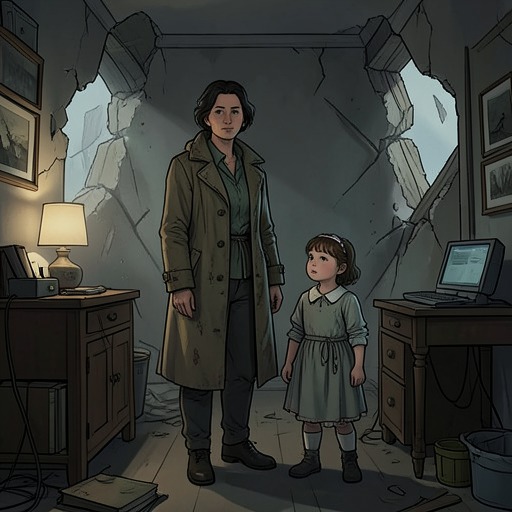
Olympia and her daughter
Bird BoxOlympia and her daughter share only a few moments together, but those moments become one of the birth scene’s most consequential acts of care. In the attic, amid pain, danger, and the collapse of the household, Olympia gives birth to a girl. Although she is mentally disoriented, she eventually places the child in Malorie’s hands. Malorie remembers that handover as Olympia doing right by her daughter even after losing her mind; it is the fragile, decisive connection between mother and child before Olympia’s death separates them.
A relationship formed in crisis
Olympia’s daughter is born during the storm-night emergency, while Malorie is also in labor and the household is under threat. The two women have no doctor, medicine, or family support to rely on. The absence of medical help has long haunted Malorie, who imagines childbirth as a swift passage from her waters breaking to holding the baby, avoiding thoughts of what happens in between. In the attic, that feared interval becomes immediate and physical: Malorie pushes out her own child while also trying to protect Olympia’s baby.
The birth does not unfold as a private meeting between mother and infant. Malorie hears Olympia’s daughter cry for the first time while still struggling through her own labor. She inches across the floor toward the newborn, her body resisting, because she wants to reach and protect the child. That effort makes the girls’ first connection depend on another woman’s physical labor: Malorie is not merely witness to Olympia’s birth but becomes the person who moves toward the baby and helps secure her safety.
The handover to Malorie
After her daughter is born, Olympia calls the infant her baby. Malorie asks to see the child and reaches for her, but Olympia initially does not simply surrender her. Malorie continues asking, even while keeping her eyes closed, and Olympia finally urges her to look. Malorie’s hands meet the newborn: she is a girl. The exchange is brief, yet it changes the immediate terms of their relationship. Olympia has given birth to the child; Malorie now receives her and takes responsibility for protecting her.
The transfer is significant because it happens while Olympia’s grasp on reality has failed. Malorie hears her gnawing at what she recognizes as the baby’s cord and feels sick, but she keeps her eyes shut and continues trying to reach the infant. The scene holds together bodily revulsion, fear, and care without turning them into separate episodes: Olympia’s condition endangers the child, while Malorie’s approach provides a way for the newborn to be taken into safer hands.
Once she has the girl, Malorie ties a second piece of towel around the baby’s eyes, extending the household’s central protective practice to the newborn. She whispers her thanks to Olympia. That gratitude is not a claim that Olympia has been well or consistently capable of care; it marks the importance of this particular act of entrustment. Malorie later remembers that Olympia did right by her daughter at this moment, despite having lost her mind. In the relationship’s brief history, the handover becomes its clearest expression of maternal responsibility.
Separation and its meaning
After giving up the infant, Olympia moves toward the attic window, where Gary is standing. She says she has been inside a long time and is going outside. Malorie calls for her to stop and asks Gary to intervene, but her appeals do not change what follows. The window glass shatters; then there is silence before Gary reports that Olympia is hanging by her cord. The daughter’s first moments are thus followed almost immediately by permanent separation from her mother.
The birth scene gives the relationship a tragic shape without erasing Olympia’s final act of care. Her daughter survives the transfer into Malorie’s hands, while Olympia dies after moving toward the broken window. Malorie’s memory preserves both facts together: Olympia’s final decision to entrust the girl to someone else, and the loss that makes the child’s future care fall to Malorie. The bond is short, but it is not empty; its defining gesture is a mother relinquishing her newborn to protect her, even as the surrounding crisis makes their separation irreversible.
Care under the rules of the new world
The newborn’s vulnerability is measured in immediate, practical actions. Malorie covers the girl’s eyes with a strip of towel, just as she protects her own baby, because the danger in this world makes sight a threat. The object is improvised rather than medical, and the protection is carried out in a room where childbirth, fear, and household danger coincide. Olympia’s daughter enters the new world already subject to its rules, and her first protection comes through the combined actions of her mother and Malorie.
That care also shows how survival is distributed among the women in the house. Malorie is exhausted and in pain from giving birth, yet she crosses the bloodied floor to reach Olympia’s child, receives her, and covers her eyes. Olympia, despite her disorientation, makes the crucial handover. Their connection is therefore not developed through ordinary time or conversation but through a sequence of embodied responsibilities: birth, reaching, surrender, receiving, and shielding. The relationship’s tenderness remains inseparable from the conditions that make it so precarious.